DESIGN THEORY

UNITING DESIGN AND ART FOR CHANGE AND JUSTICE

THE 7 C’s for sustainabLE DESIGN

A NEW DESIGN THEORY BY ROBIN OWENS
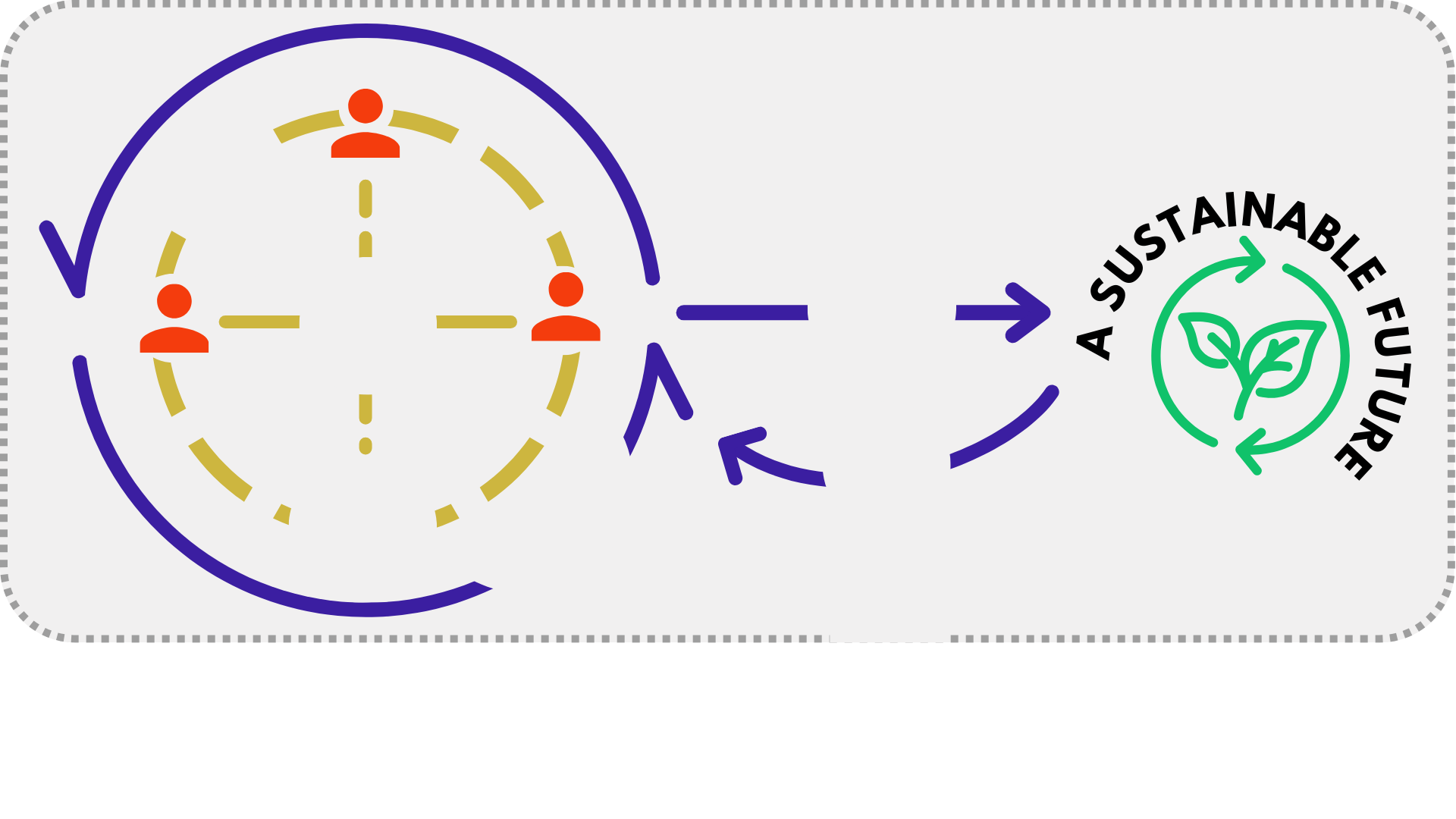
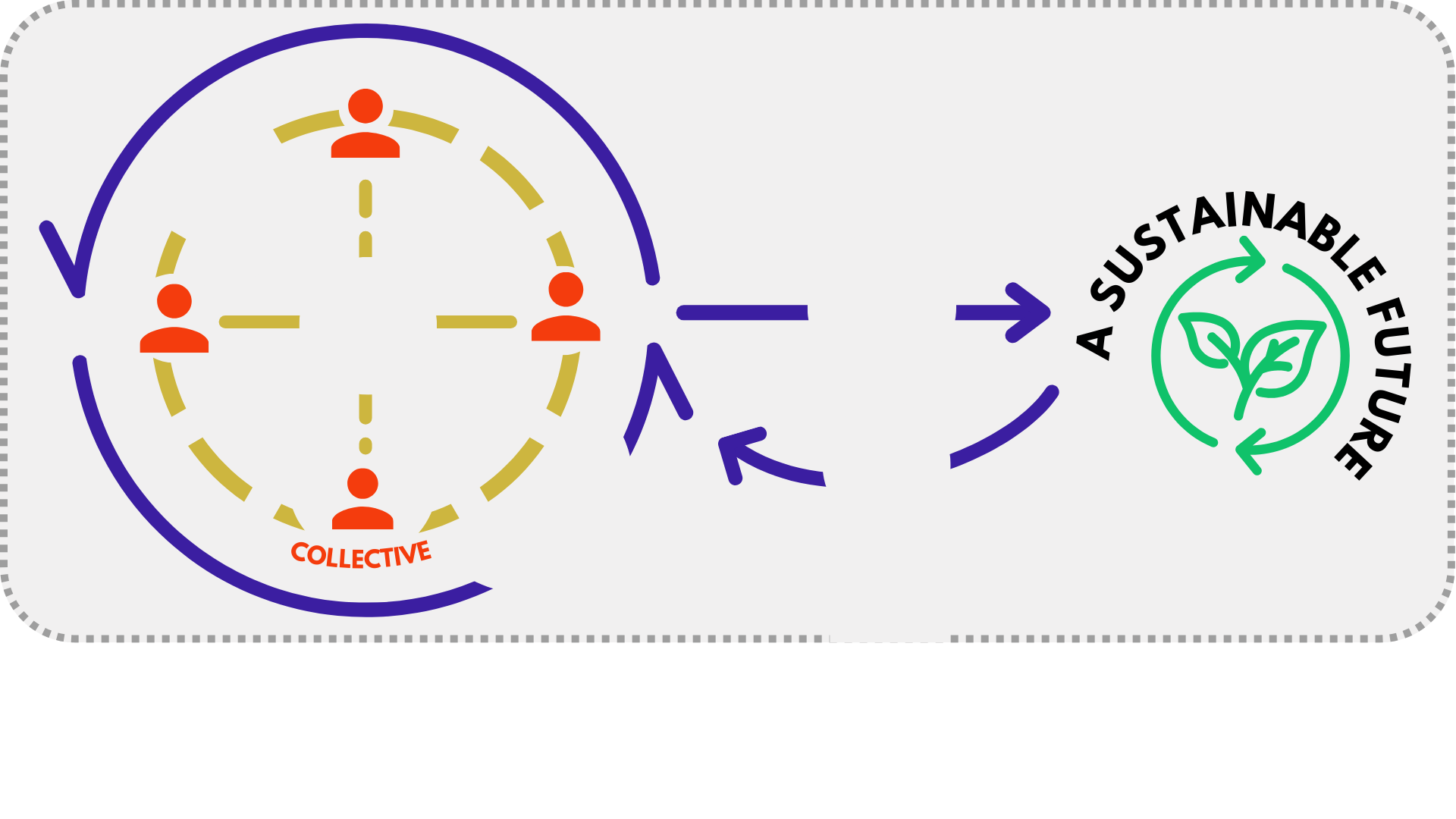
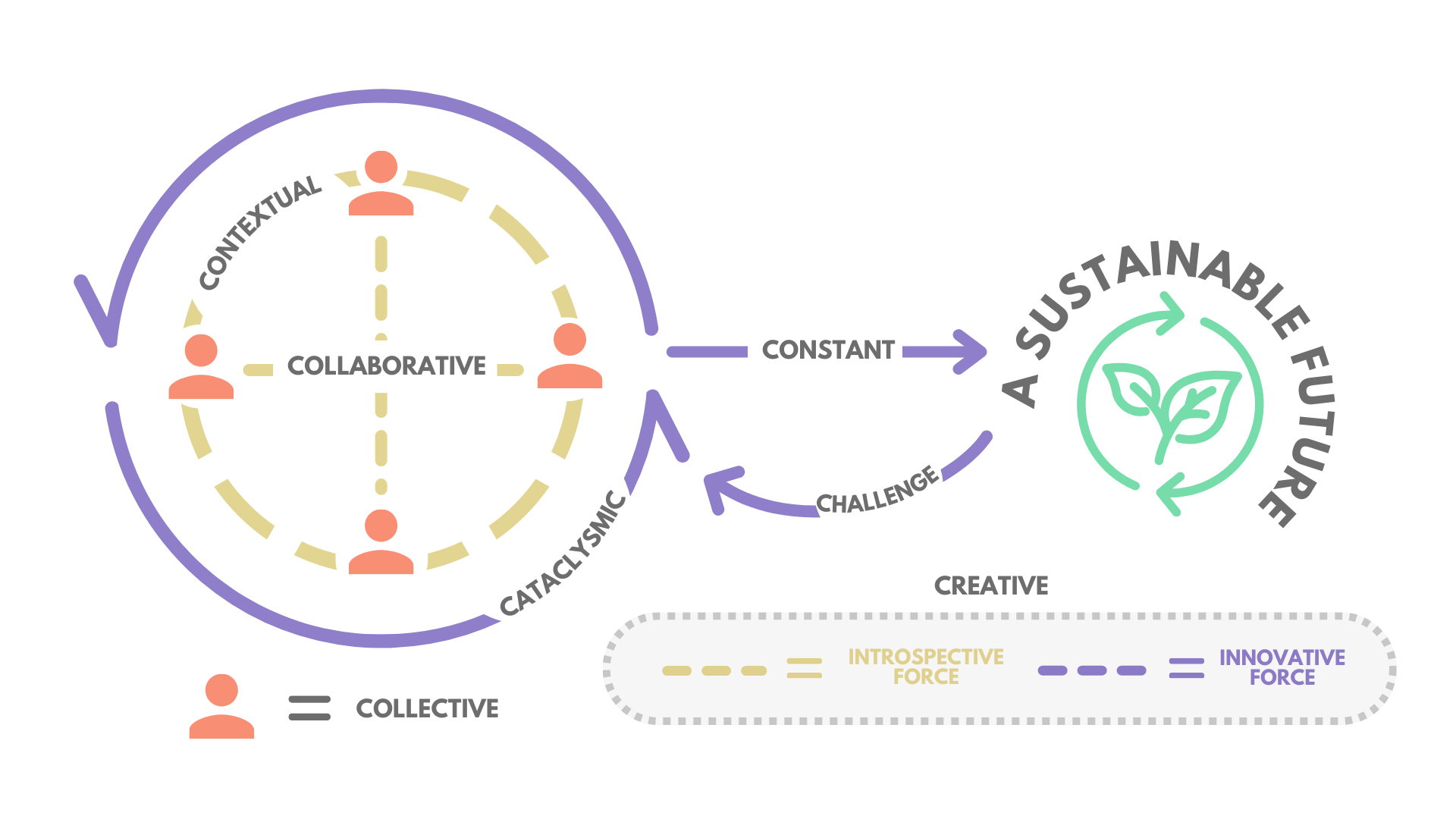
An infographic illustrating the cycle of sustainability, featuring a clock with four human icons around it. The cycle leads to a logo with a leaf inside a circle and the text 'A Sustainable Future' encircling it.
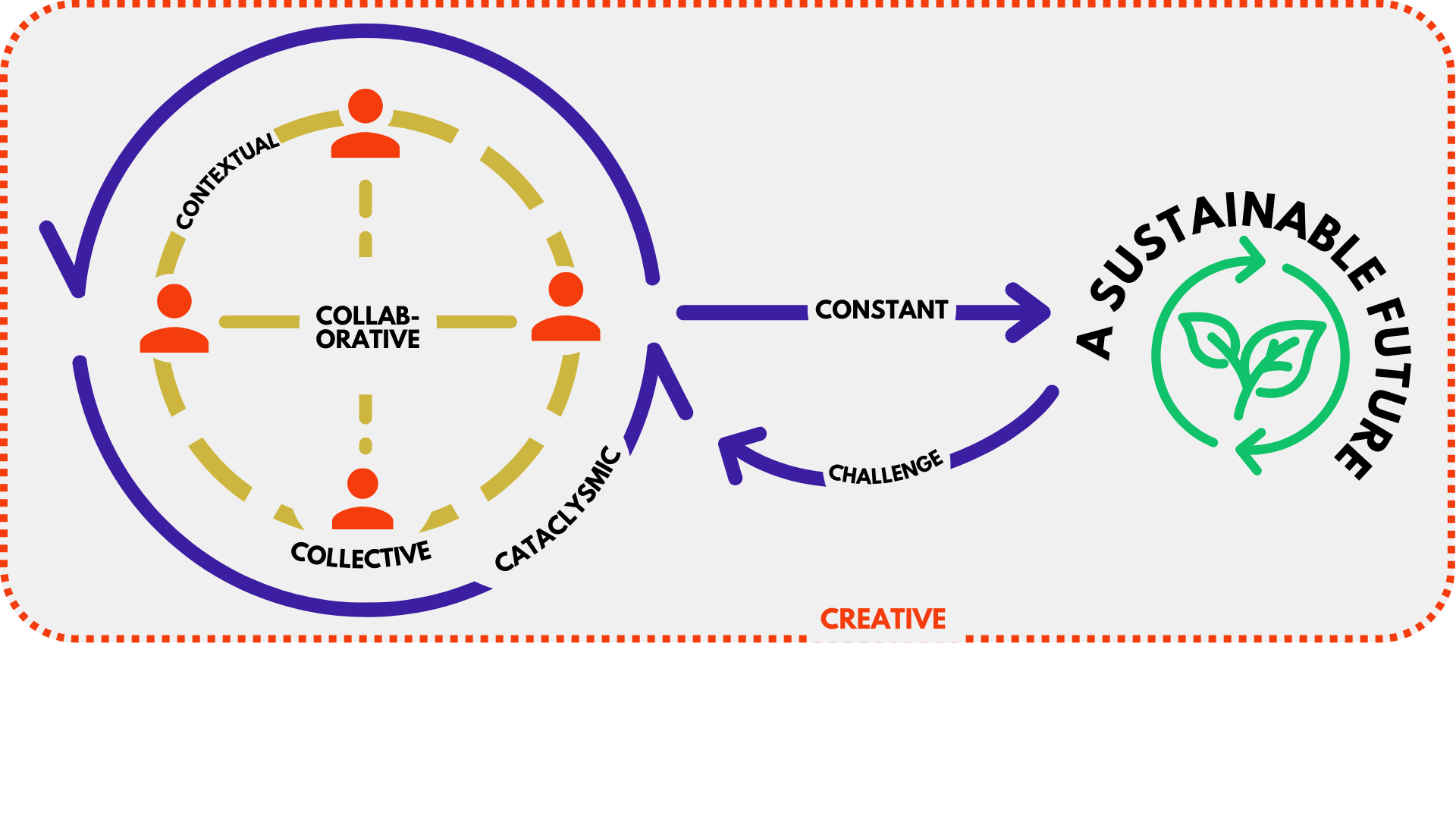
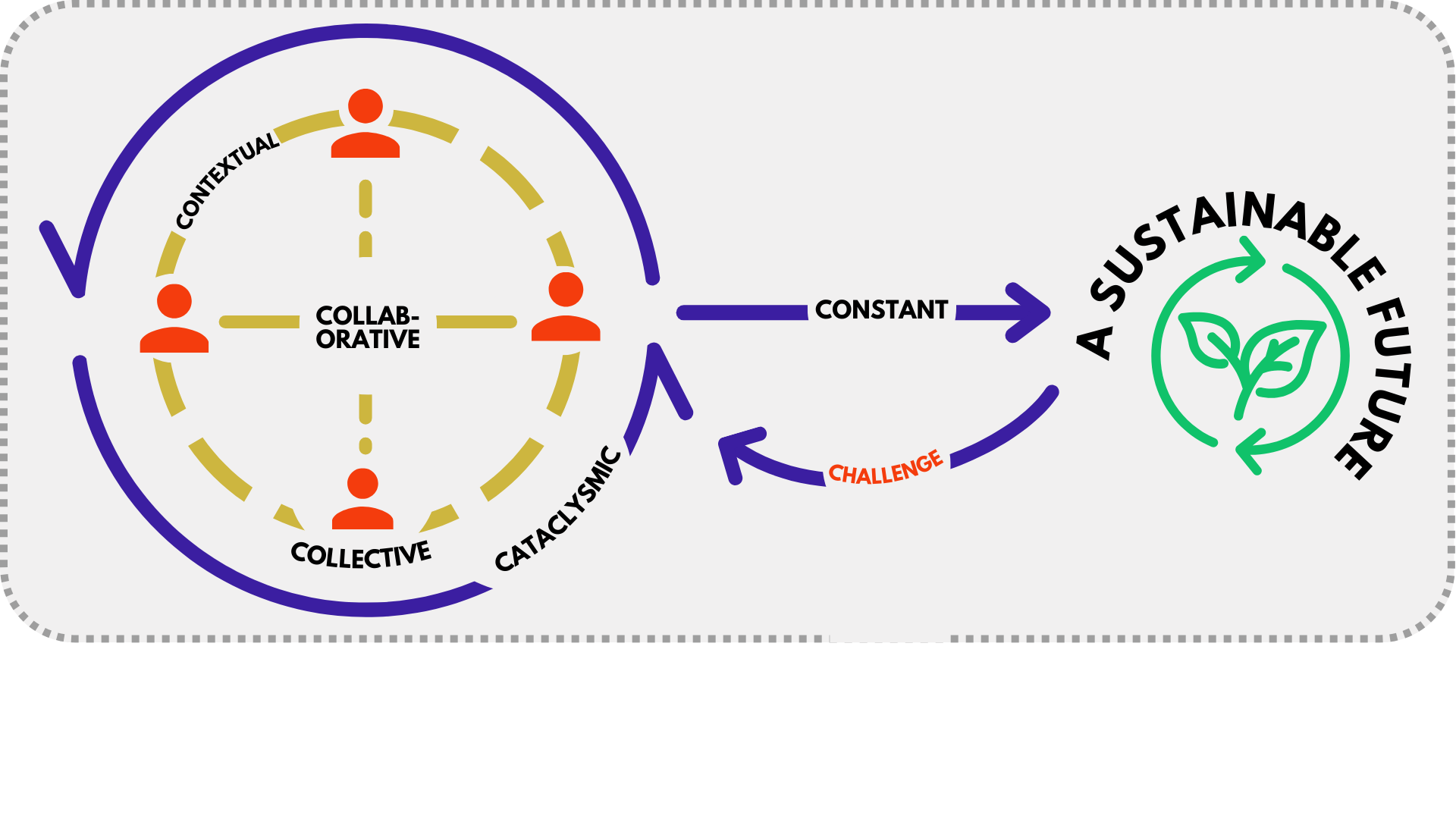
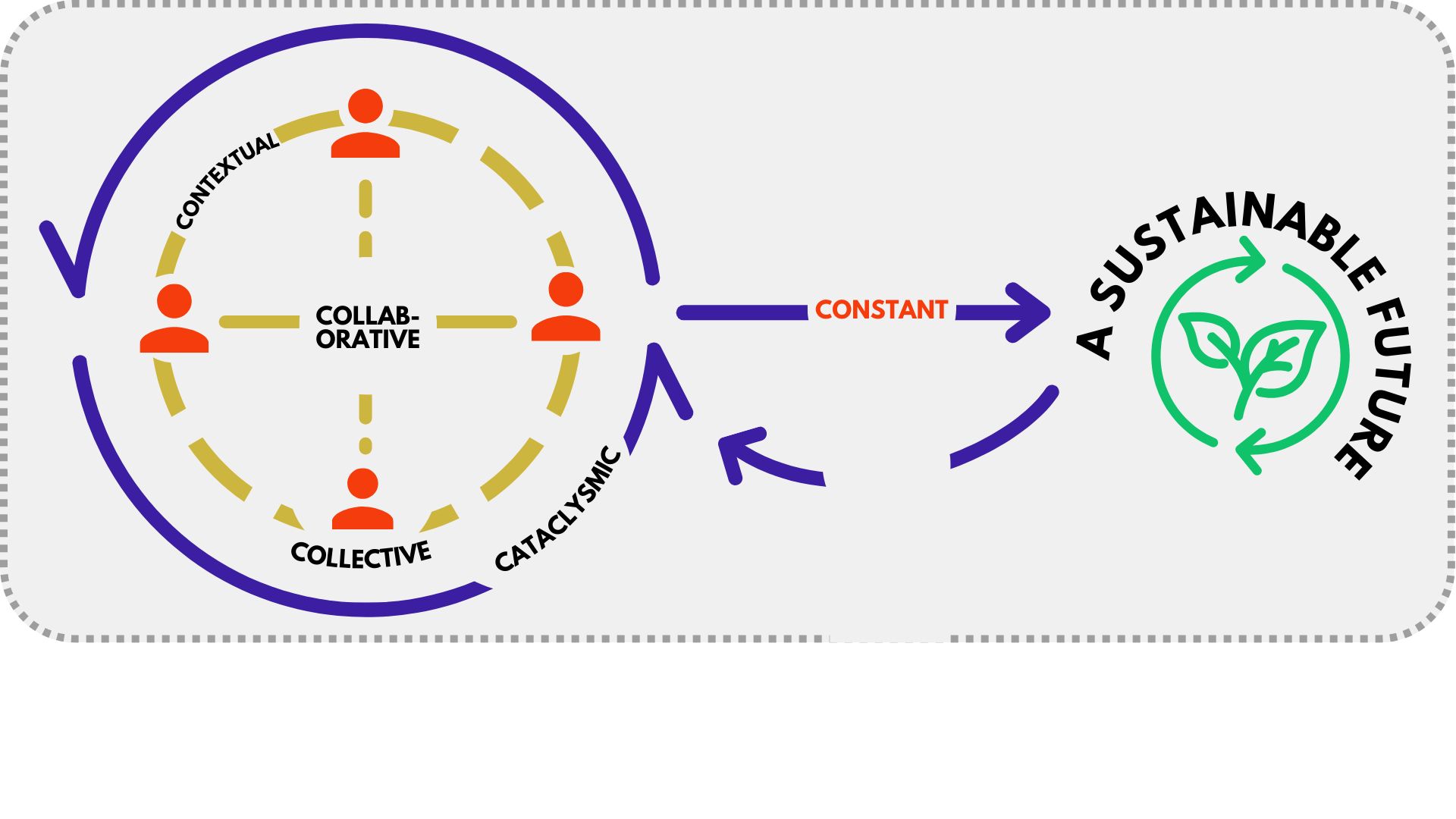
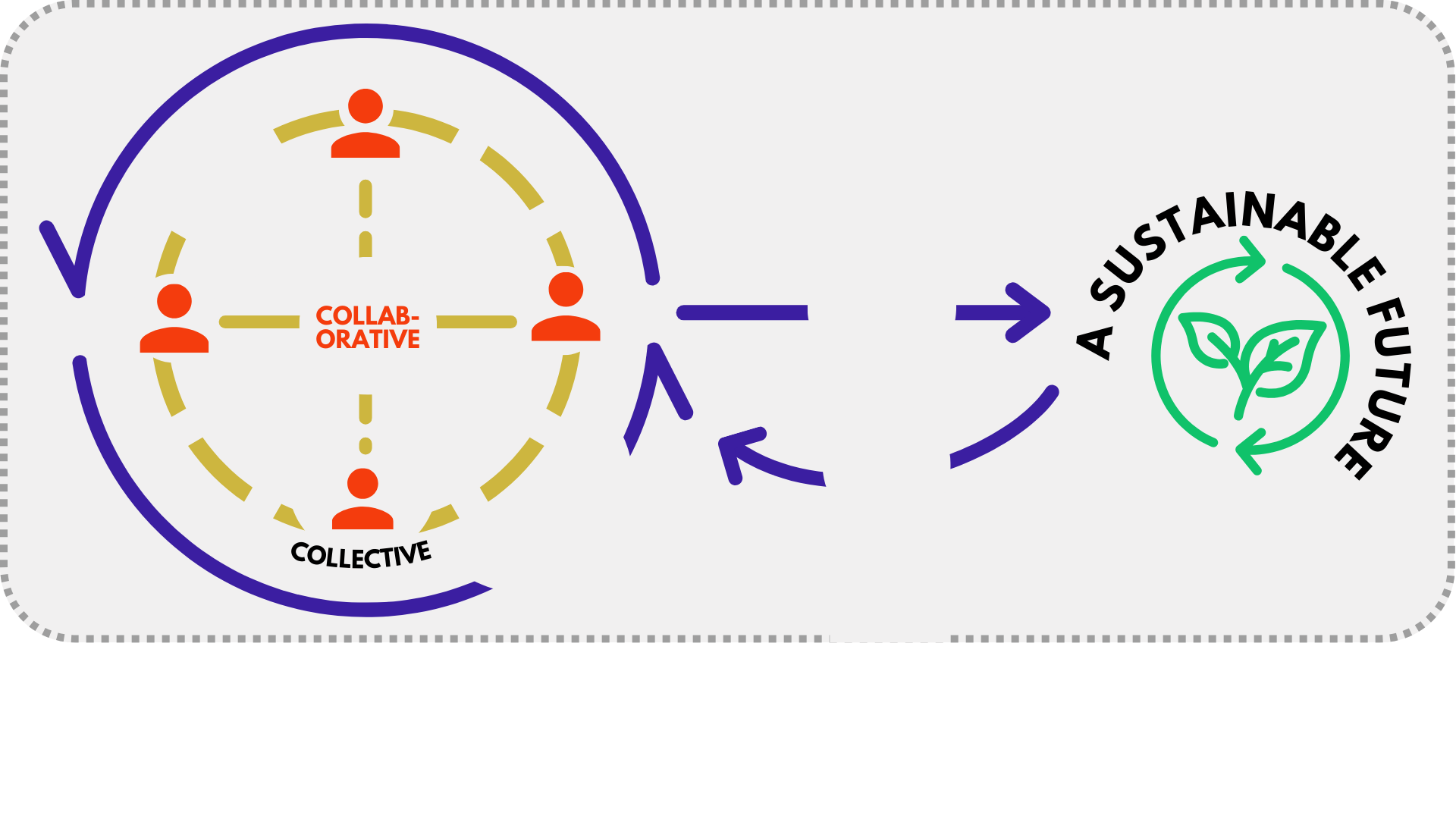
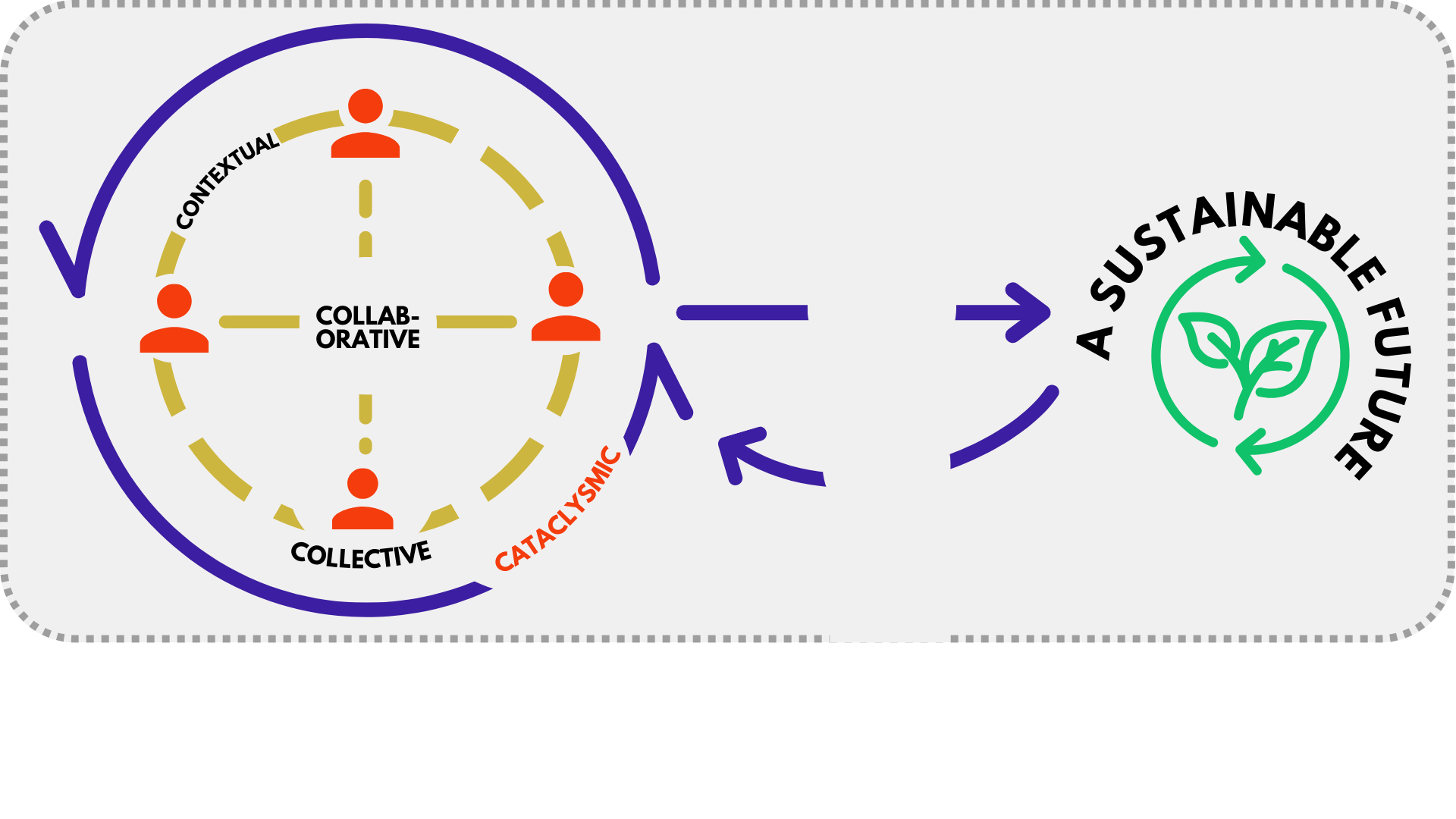
A diagram showing a creative process leading to a sustainable future, with stages: collective, contextual, collaborative, cataclysmic, challenge, constant, and a final goal of sustainability, depicted with arrows and icons.
A circular diagram showcasing the transition from collective, contentual, and catastrophic collaboration to a constant challenge, leading to a sustainable future represented by a green plant inside a circle with arrows.
Diagram illustrating a cycle of collective, contentious, and catalytic actions leading to constant collaboration for a sustainable future, with a green recycle symbol and arrows connecting the concepts.
A diagram illustrating a collaborative approach to creating a sustainable future, featuring interconnected people, the words "collaborative" and "collective," arrows, and a green icon of a plant within a circle labeled "a sustainable future."
Diagram illustrating a sustainable future through collective effort, featuring interconnected arrows, stylized human figures, and a circular arrow surrounding a leaf symbol with the text 'A Sustainable Future'.
A diagram illustrating a process for achieving a sustainable future through collective, collaborative, and contextual efforts, emphasizing the importance of addressing systemic issues in a way that is environmentally friendly.
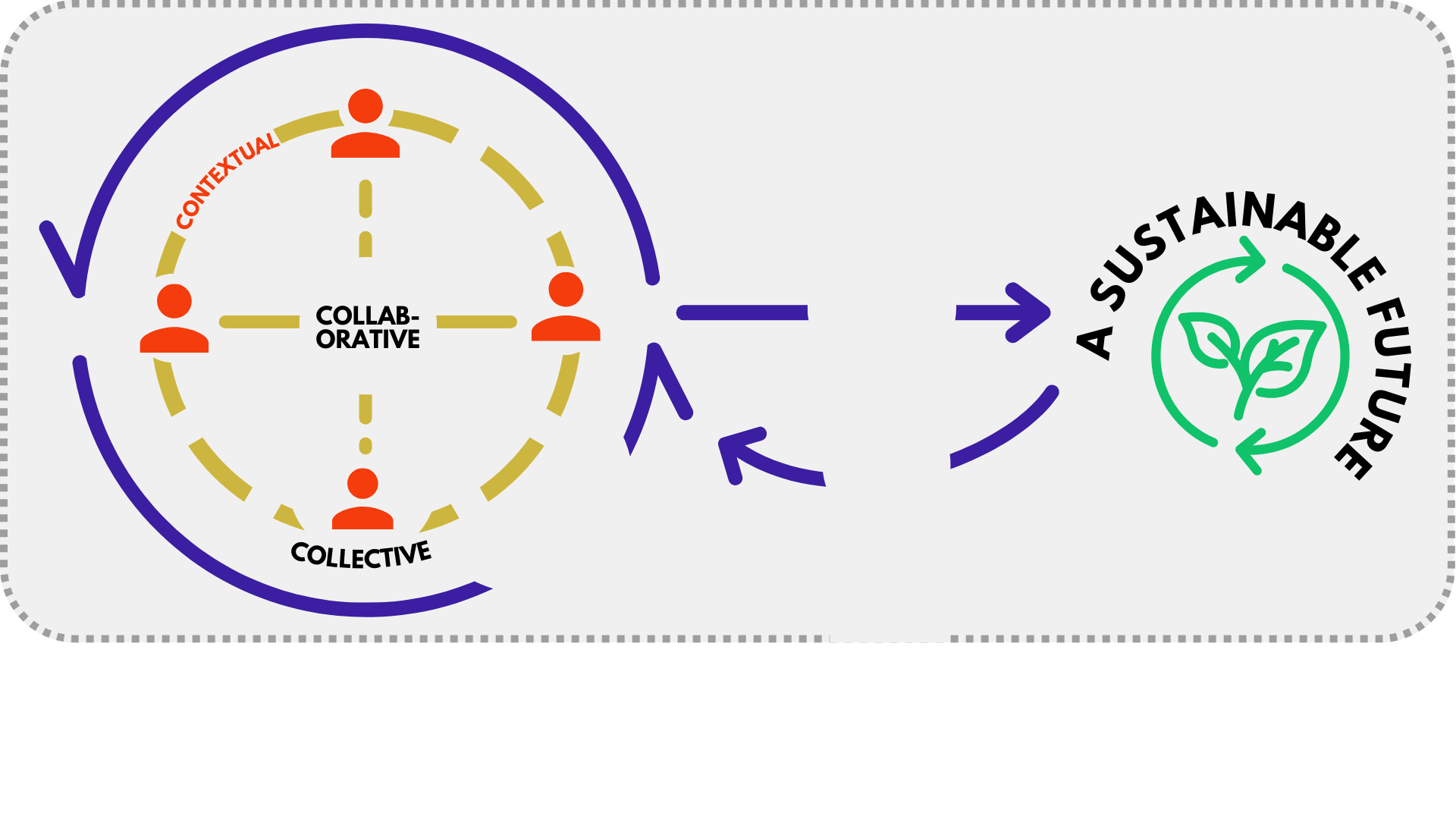
A diagram illustrating a process aimed at creating a sustainable future through collective collaboration and contextual understanding.
Red circular badge with the number 4 in white
Red circle with the white number 3 in the center.
Red circular sign with the number 2 in white.
Red circle with a white number one in the center.
Red circle with the number five in white
Red circle with the white number six in the center
Red circle with the white number seven in the center

BACK

RESET

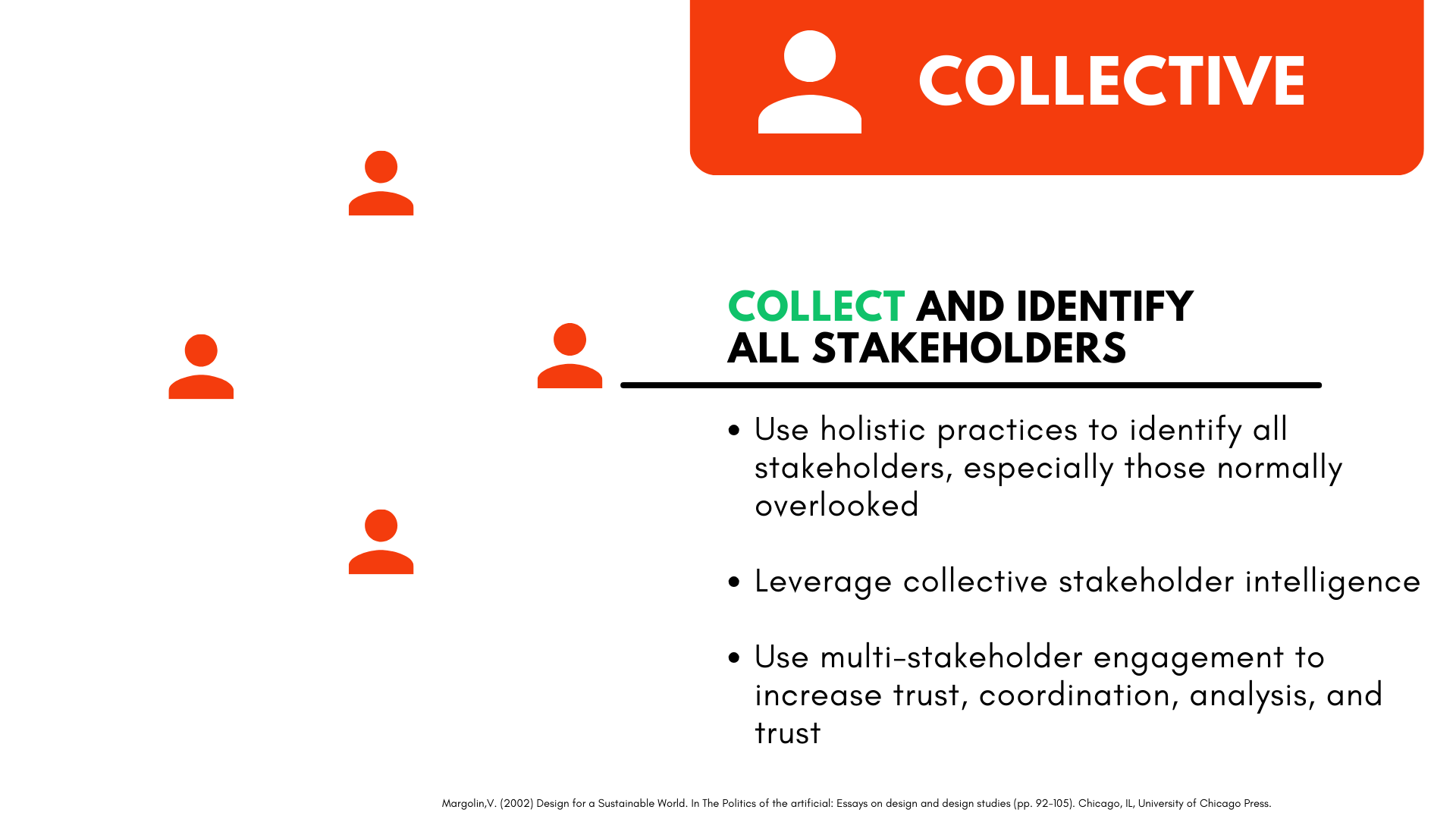
A presentation slide emphasizing the importance of collecting and identifying all stakeholders in a group, with a focus on holistic practices and leveraging collective stakeholder intelligence.
A diagram illustrating a process for achieving a sustainable future, featuring interconnected concepts such as collective, collaborative, contextual, catastrophic, creative, challenge, constant, and innovative forces.
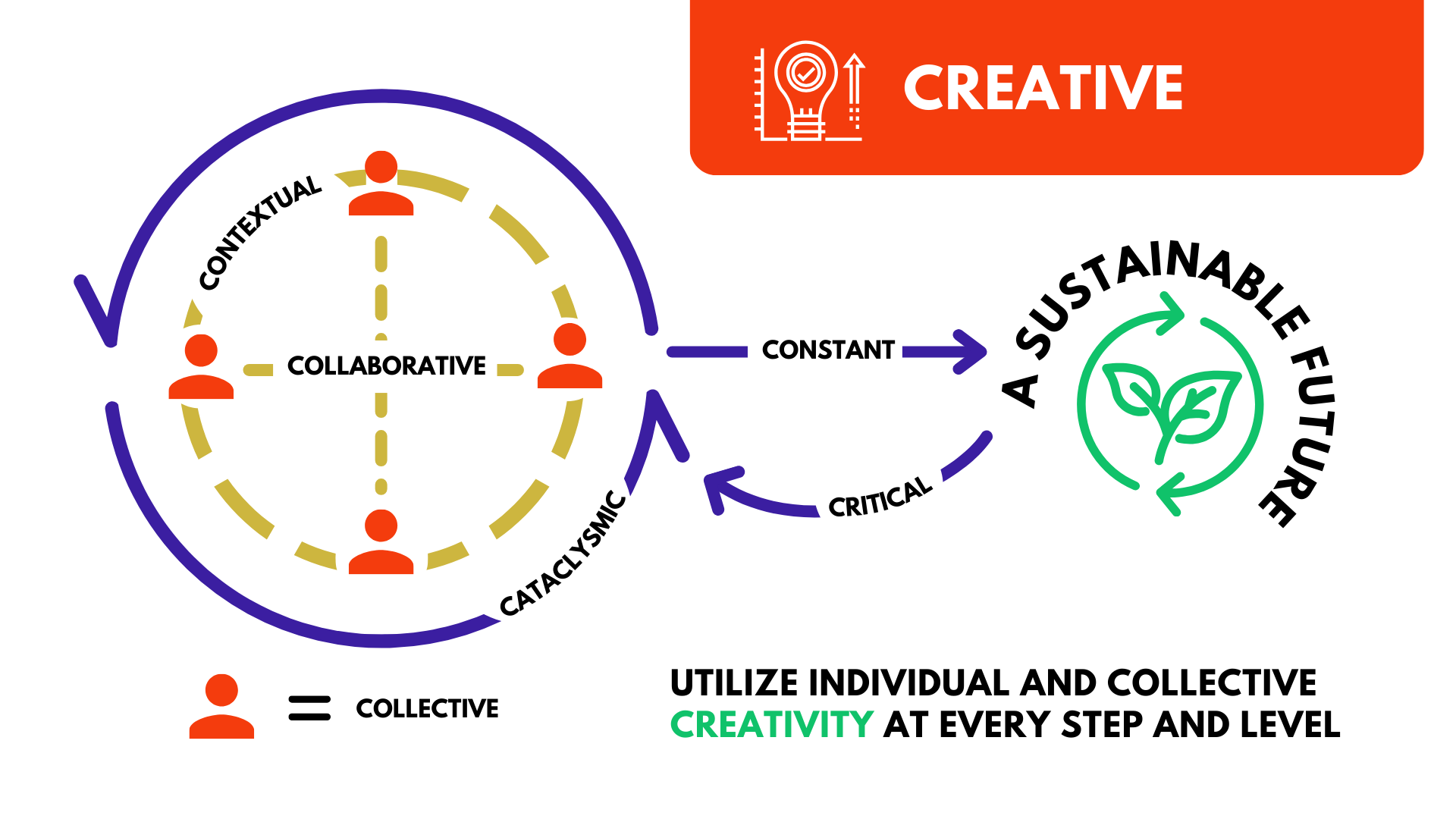
Flowchart illustrating the process of fostering creativity through a cycle of collaboration, contextual understanding, critical thinking, and sustainability, emphasizing utilizing individual and collective creativity at every step and level.
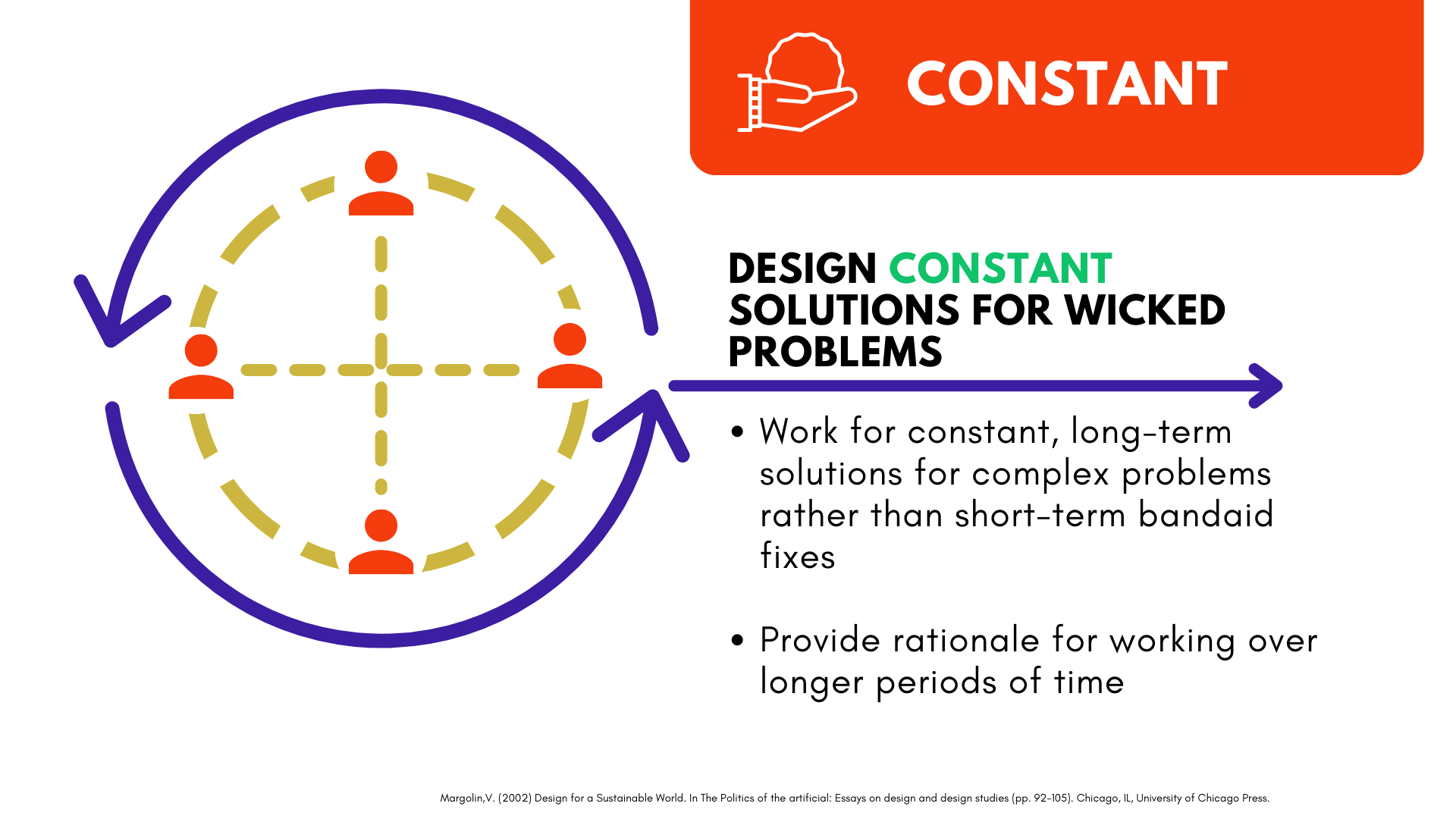
Graphical presentation of the concept of constant solutions for wicked problems, featuring a circular diagram with three human icons connected by orange dashed lines, a large purple arrow encircling the diagram, and text emphasizing work for constant, long-term solutions over short-term fixes.
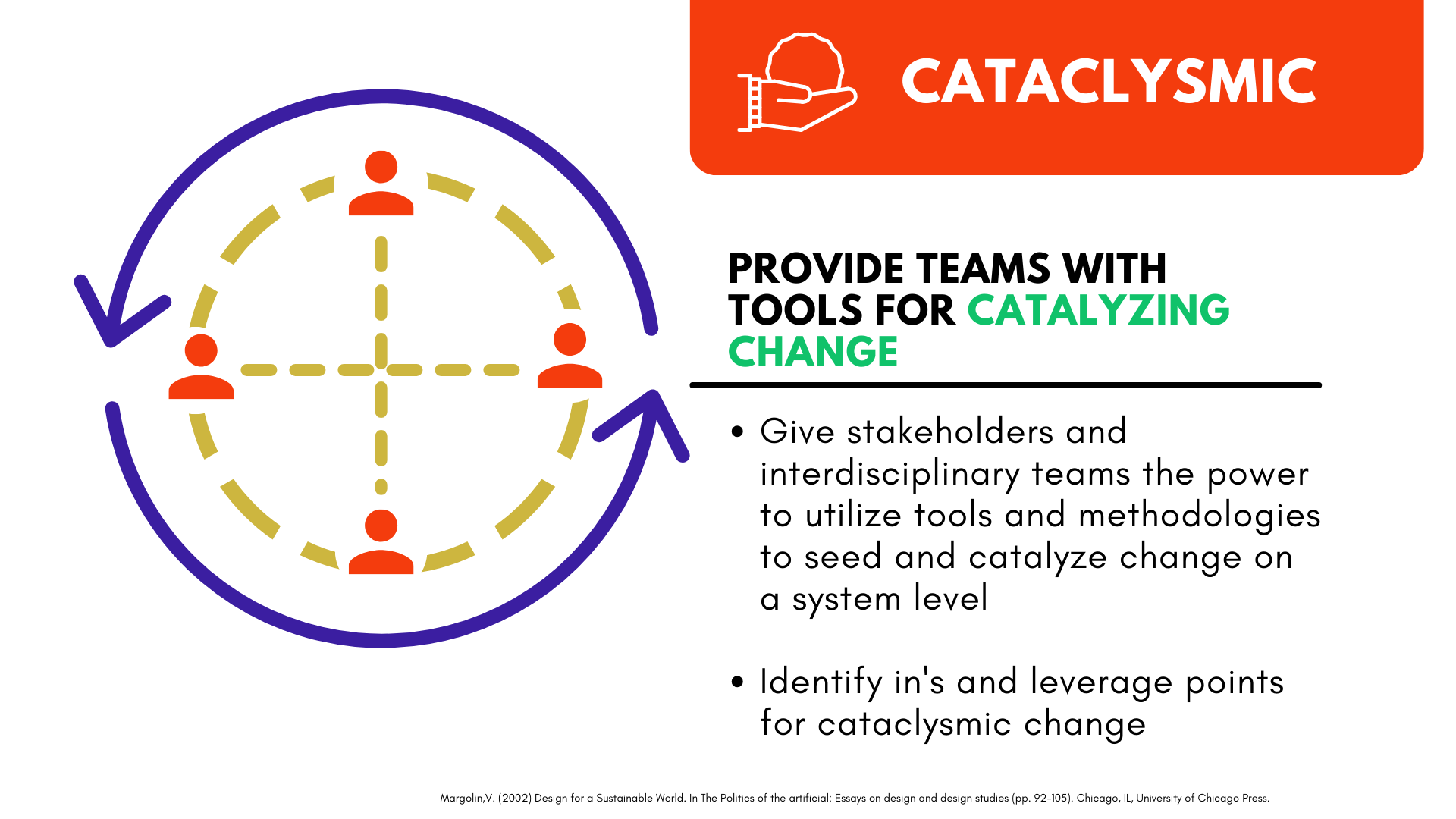
Diagram illustrating the concept of catalyzing change with interconnected stakeholders around a circular process, accompanied by text about providing tools for catalytic change.
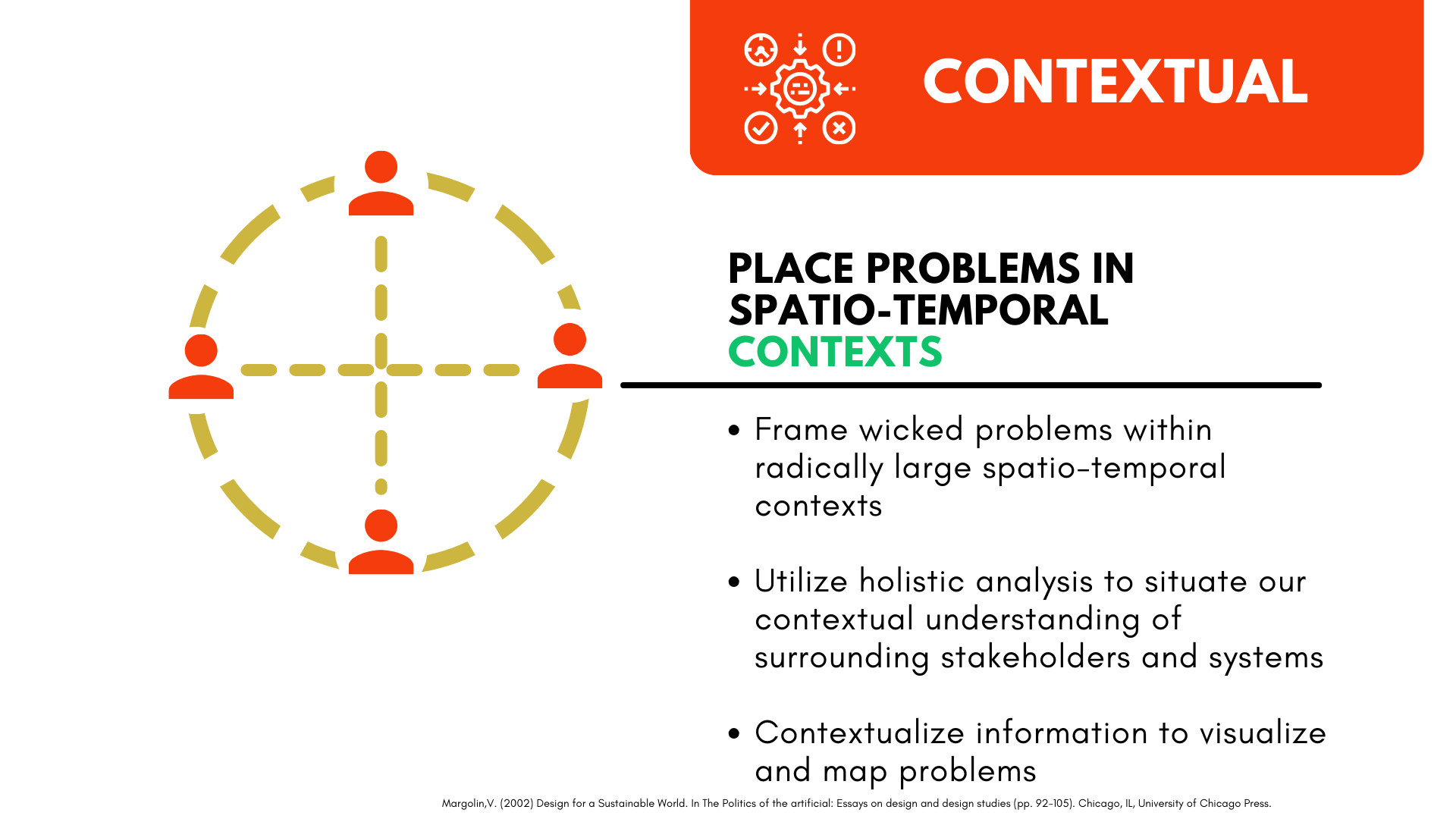
A diagram showing four red human icons at the top, right, bottom, and left of a dashed circular outline with a gear icon in the center. A section of the image has a red background with the word 'CONTEXTUAL' in white, along with icons representing settings, checkmarks, crosses, and exclamation points. To the right, text discusses placing problems in spatio-temporal contexts.
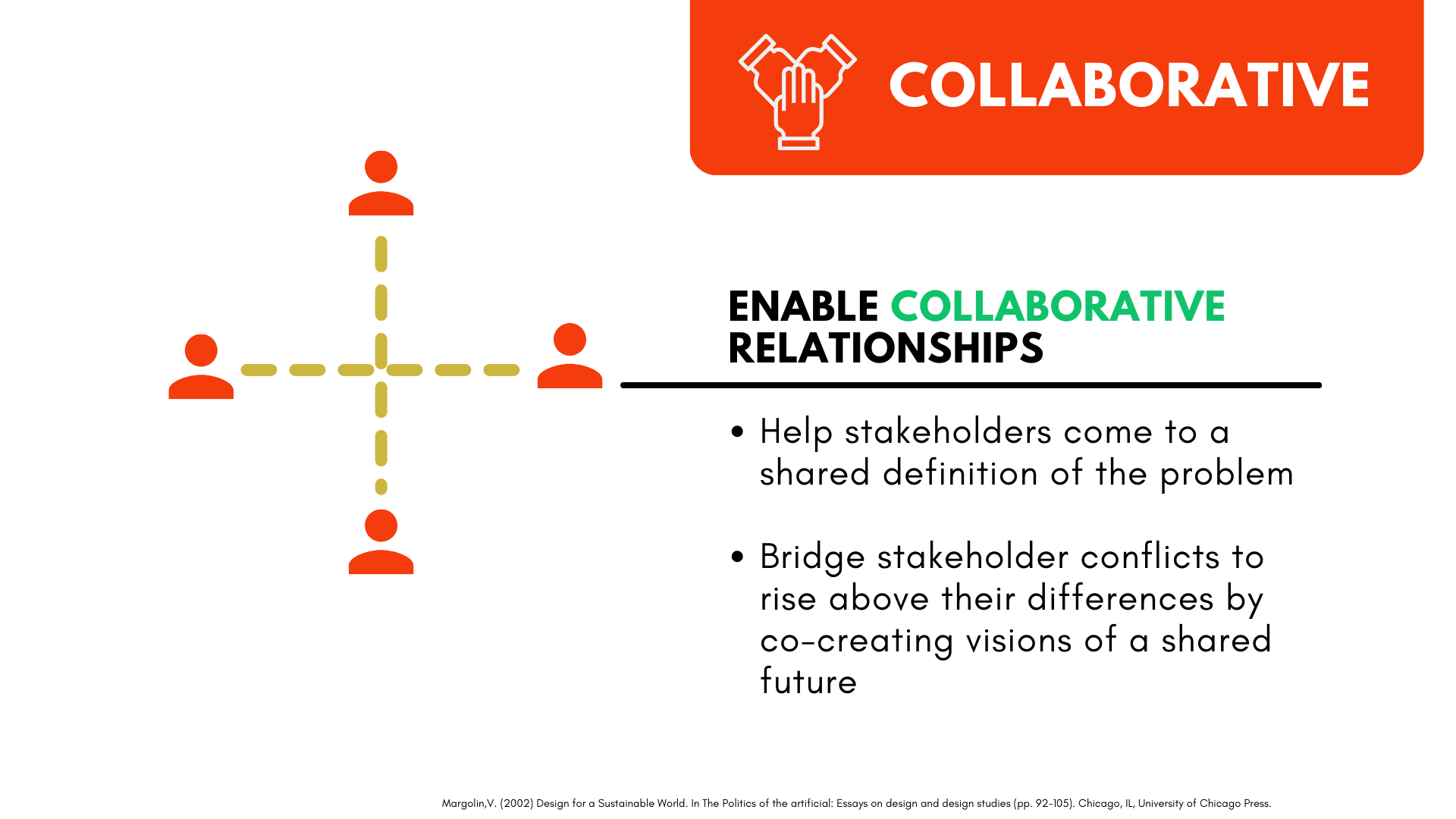
Diagram illustrating the concept of collaboration with four red person icons connected by yellow dotted lines to a central point, emphasizing shared relationships and stakeholder engagement.
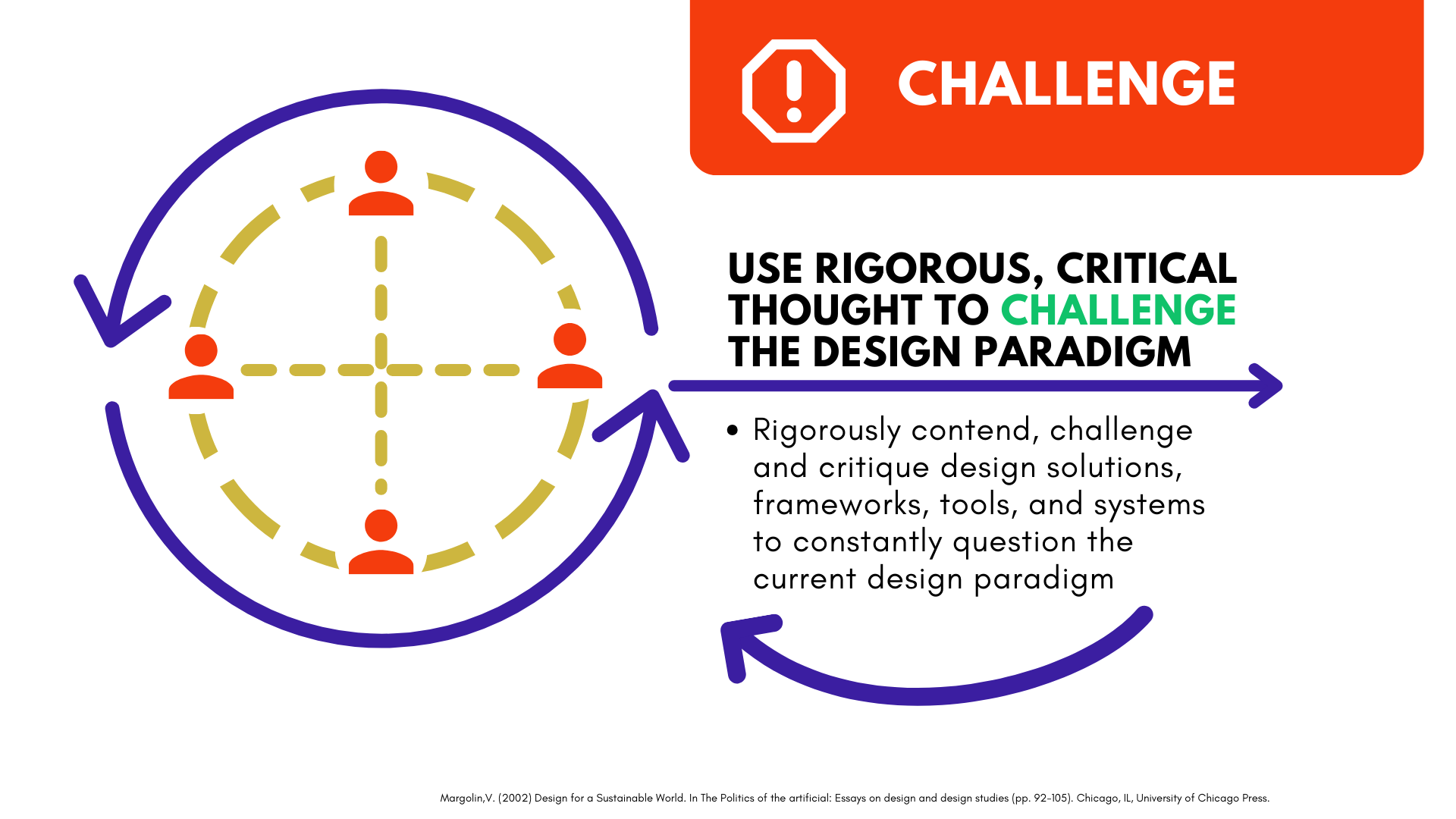
A design infographic with a circular diagram of four orange human figures connected by dotted yellow lines, and purple arrows indicating a cycle. The image contains the words 'Challenge' with an exclamation mark in a stop sign icon, and text urging rigorous critique and questioning of design solutions.

A BRIEF HISTORY OF SUSTAINABLE DESIGN
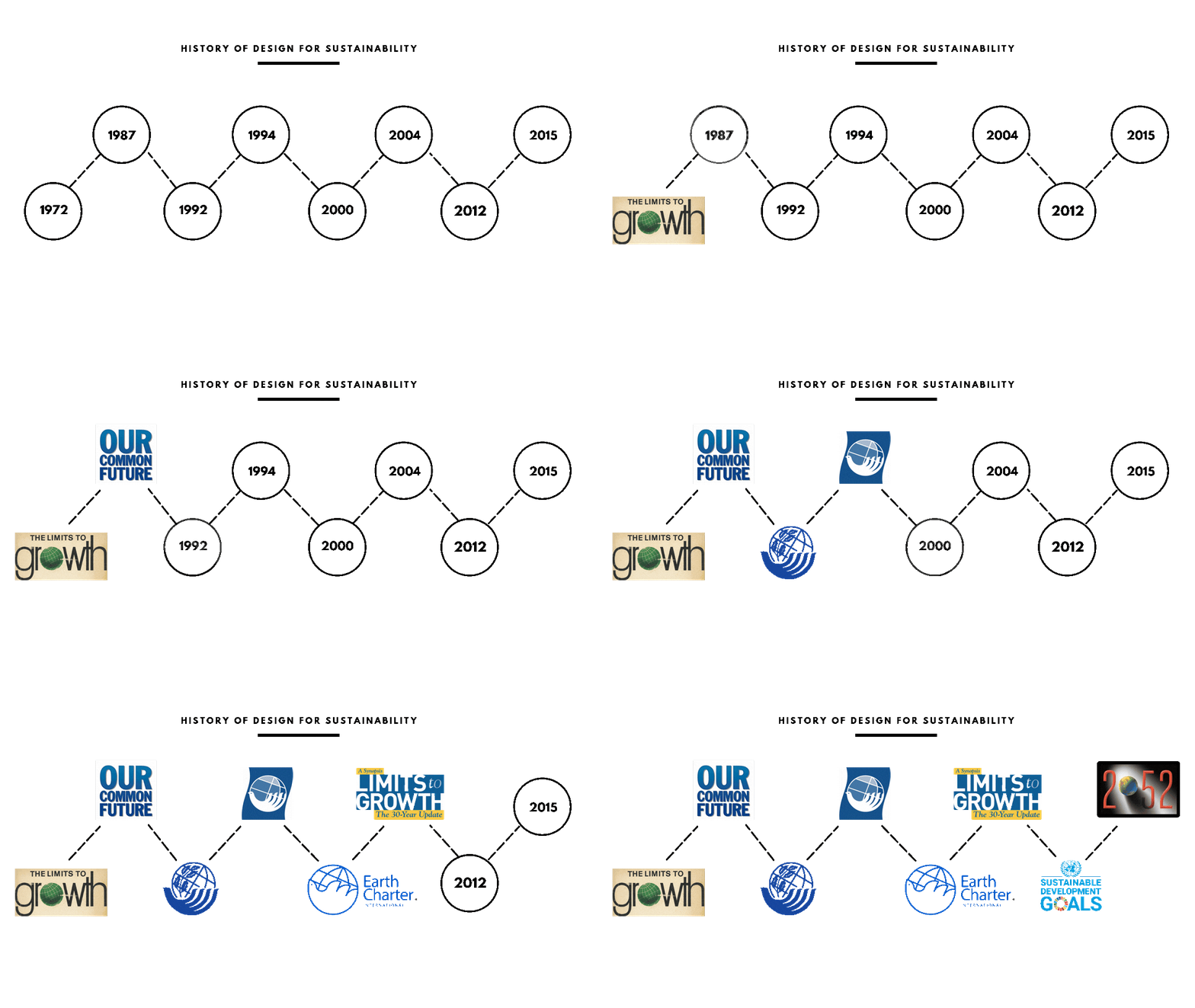
Timeline graphic titled "History of Design for Sustainability" showing a series of circles with years: 1972, 1987, 1992, 1994, 2000, 2004, 2012, 2015, connected by dashed lines.

MODELS FOR DESIGN

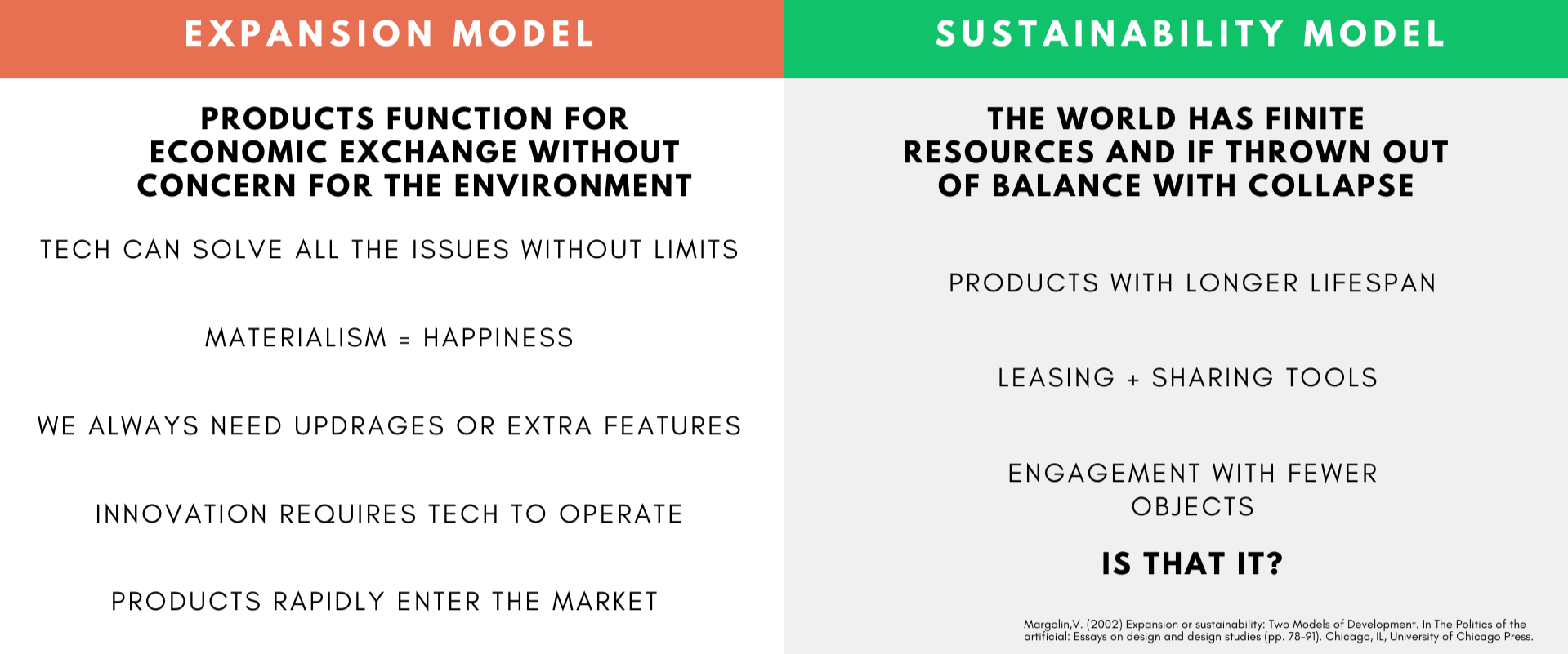
Comparison of expansion model and sustainability model of development. The expansion model emphasizes continuous growth and resource use, while the sustainability model highlights finite resources, longer lifespan products, leasing and sharing tools, and fewer objects for engagement.

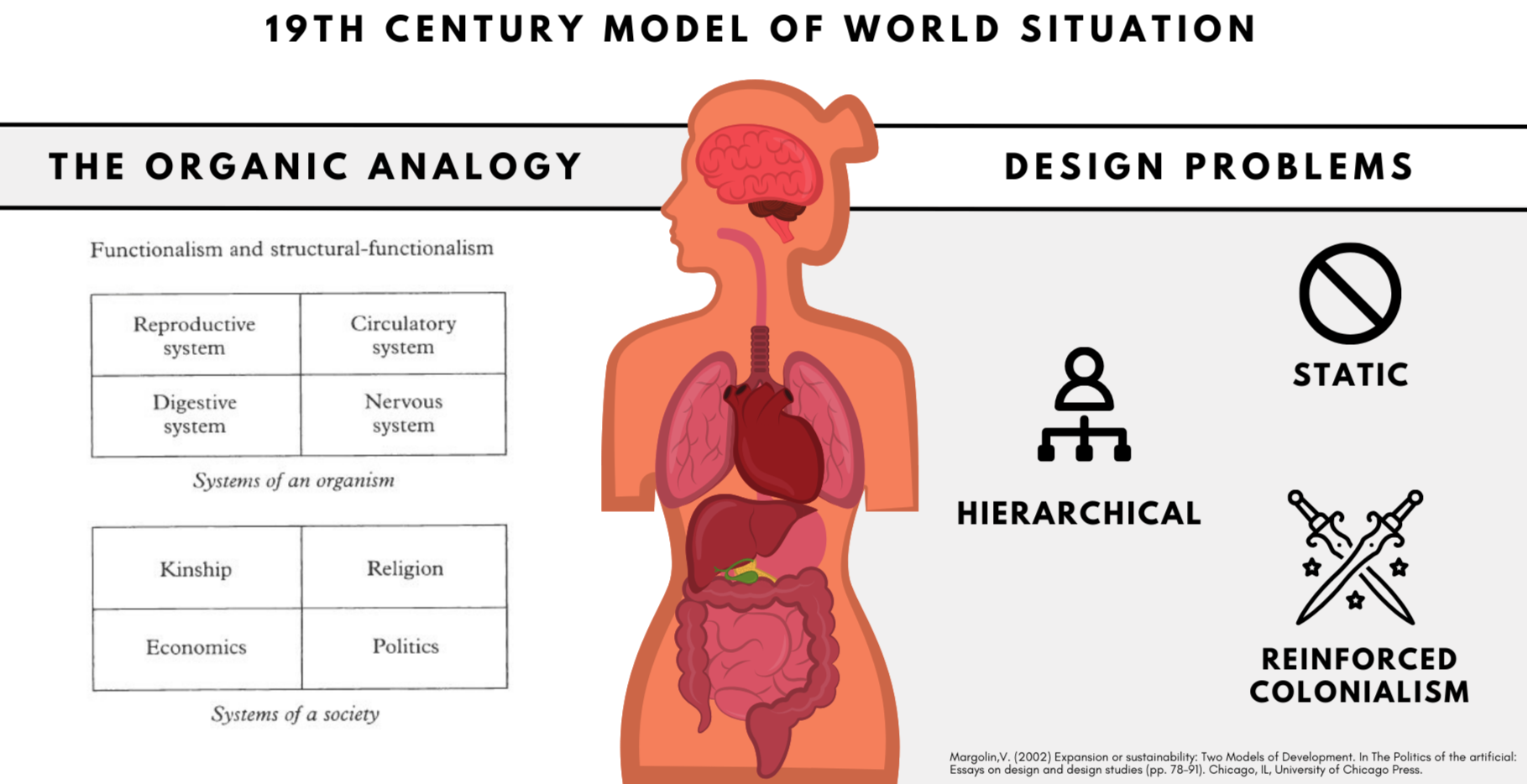
CONTEMPORARY

Diagram comparing the human body to a system of organization, with labels for hierarchical, static, and reinforced colonialism, alongside a chart of systems of an organism and societal systems, and an illustration of the human anatomy with a focus on internal organs.

PAST

SUSTAINABLE DESIGNER TOOLKITS

THEORIES FOR SUSTAINABLE DESIGN

SYSTEMS THEORY
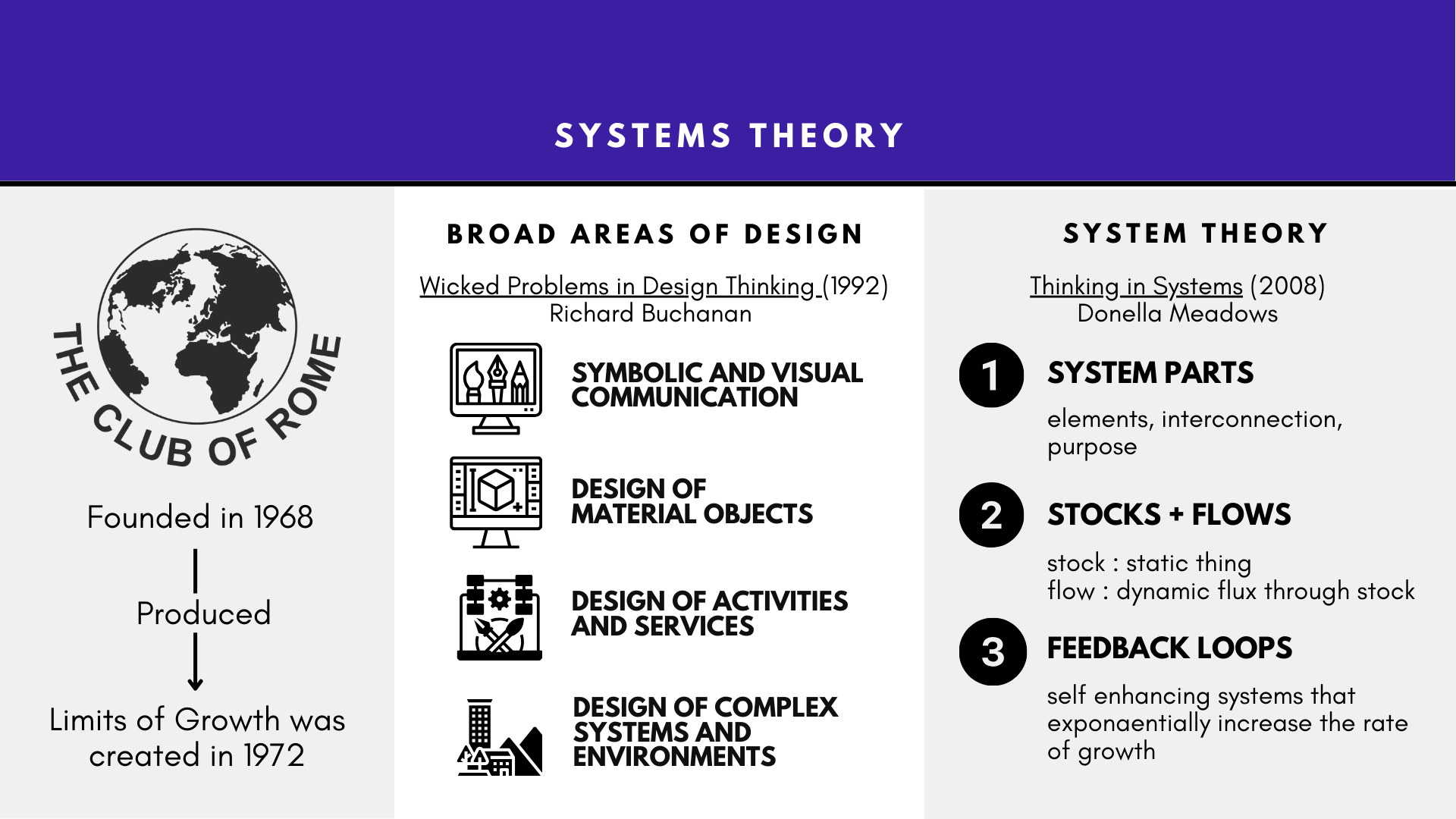
Diagram of systems theory with labeled components and a logo of The Club of Rome, founded in 1968, and a timeline of the organization's history and produced limits of growth by 1972.
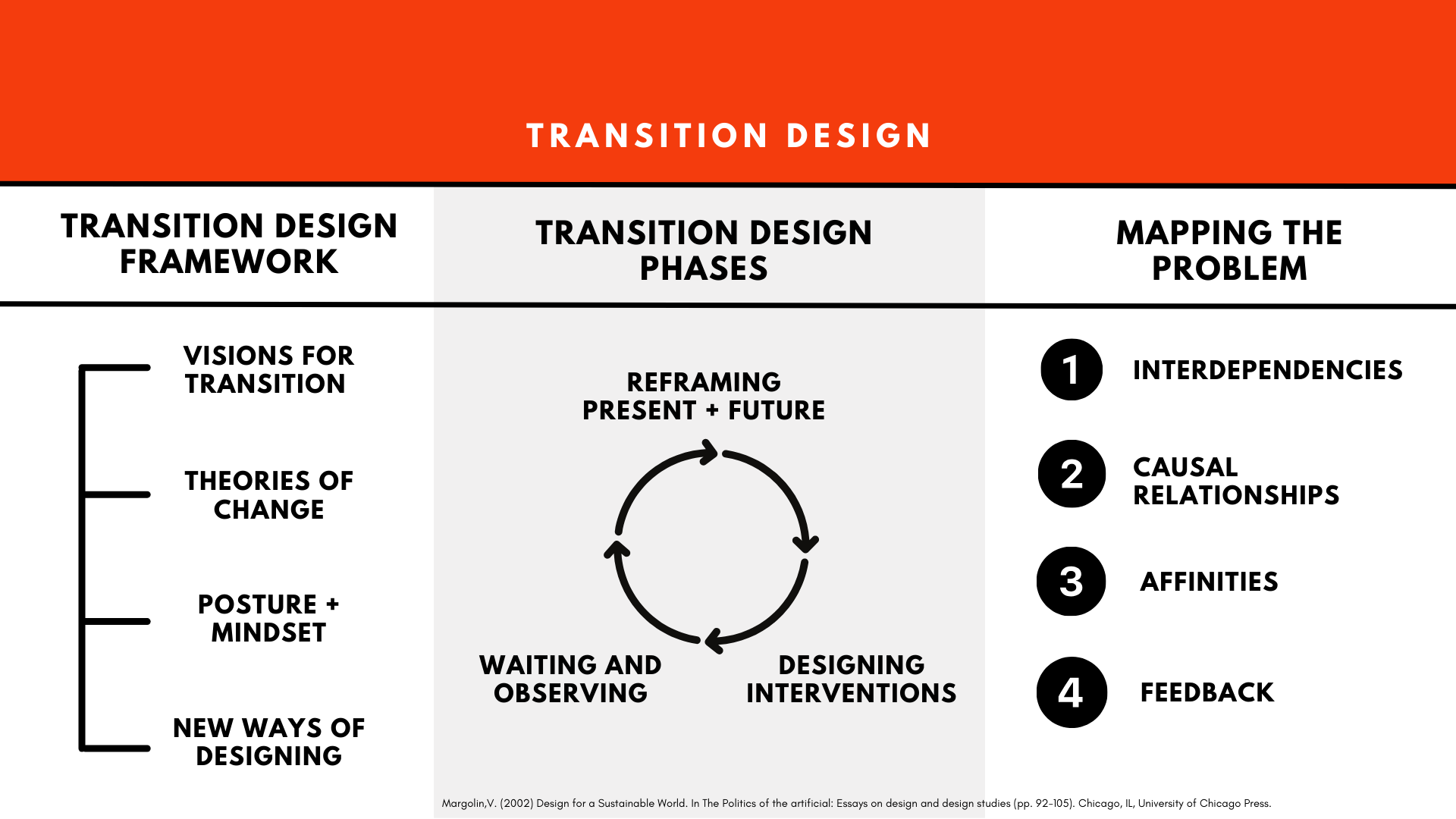
Diagram illustrating the phases of transition design, including reframing present and future, designing interventions, waiting and observing, forming cycles.

TRANSITION DESIGN

CAUSAL LOOPS

A System’s Thinking Tool
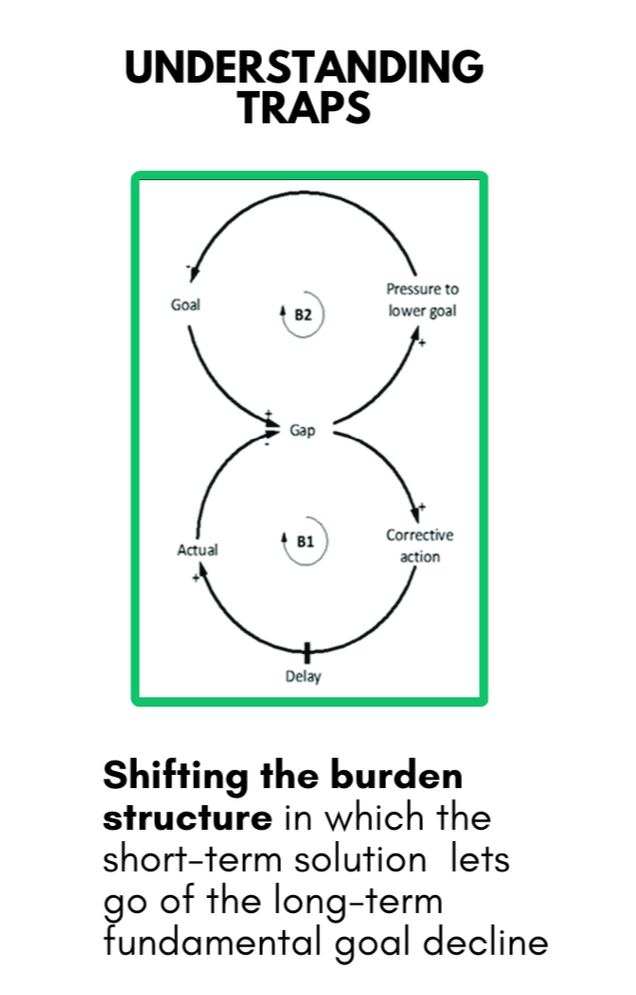
Diagram illustrating the concept of understanding traps in goal setting, featuring two interconnected cycles labeled B1 and B2. B1 represents the gap between actual performance and the goal, with delay and corrective action. B2 shows pressure to lower the goal, which can undermine the original goal, leading to a cycle of shifting the burden and avoiding long-term fundamental goal decline.
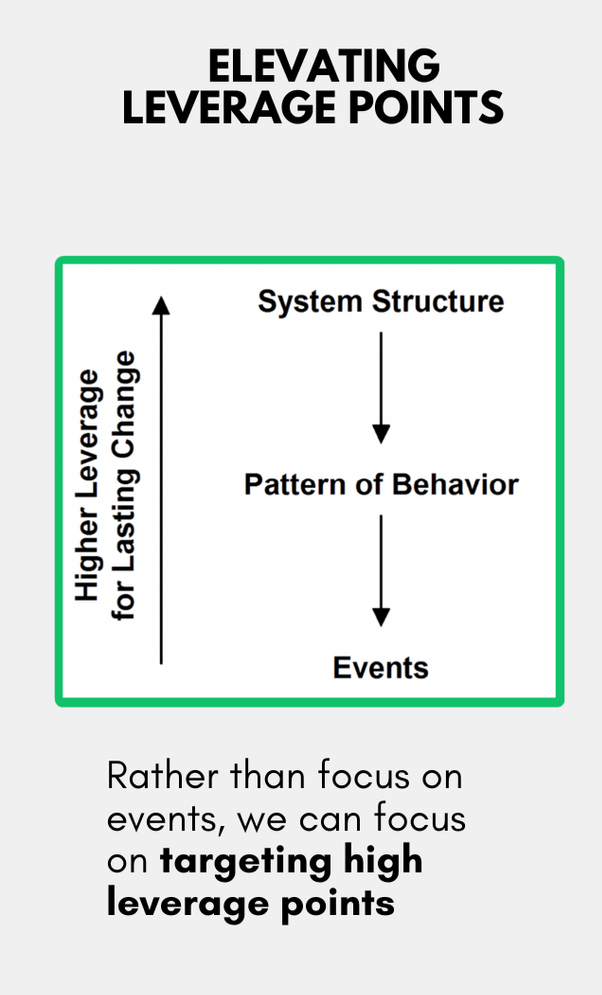
Diagram illustrating how to elevate leverage points, showing a flow from system structure to pattern of behavior to events, with an emphasis on focusing on high leverage points for lasting change.

ELEVATING LEVERAGE POINTS

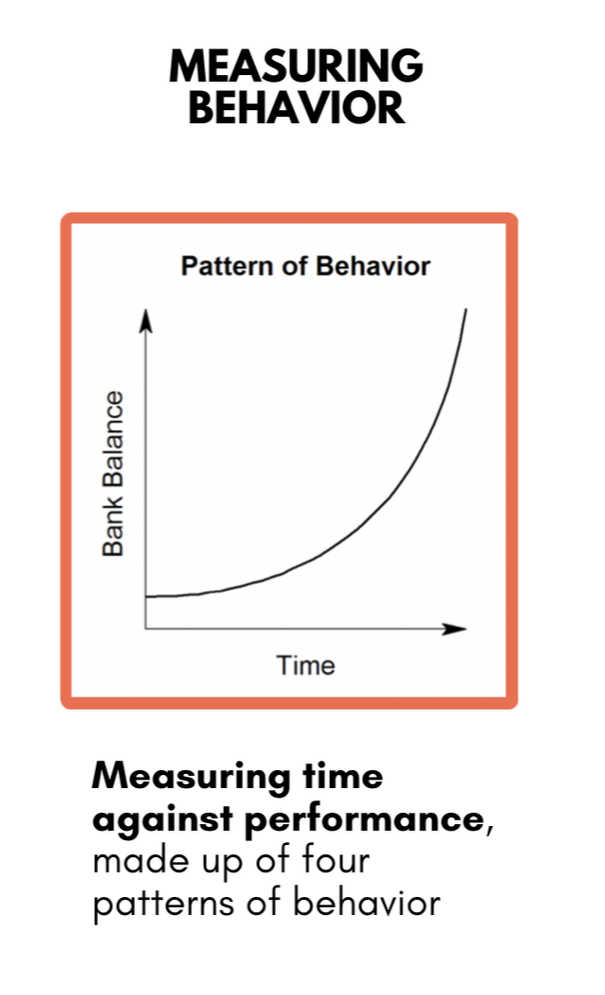
Title: Measuring Behavior. A graph labeled Pattern of Behavior showing Bank Balance on the vertical axis and Time on the horizontal axis, with a curved line indicating increasing behavior over time. Text below states: Measuring time against performance, made up of four patterns of behavior.

MEASURINg BEHAVIORS

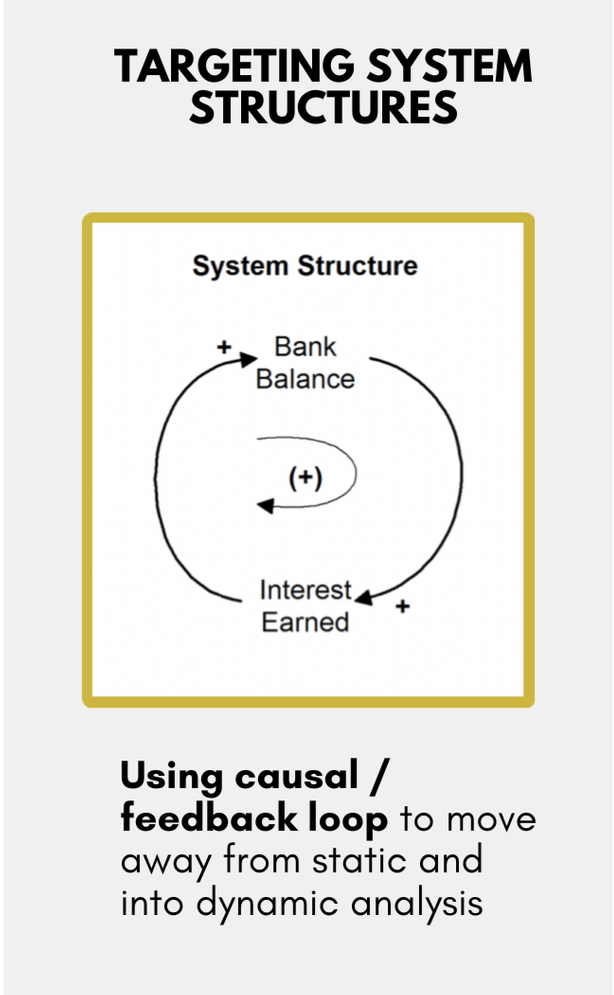
Diagram illustrating the system structure of targeting system structures, showing a feedback loop between bank balance and interest earned with positive feedback, and emphasizing the use of causal or feedback loops to transition from static to dynamic analysis.

TARGETInG STRUCTURE SYSTEMS

UNDERSTANDing TRAPS
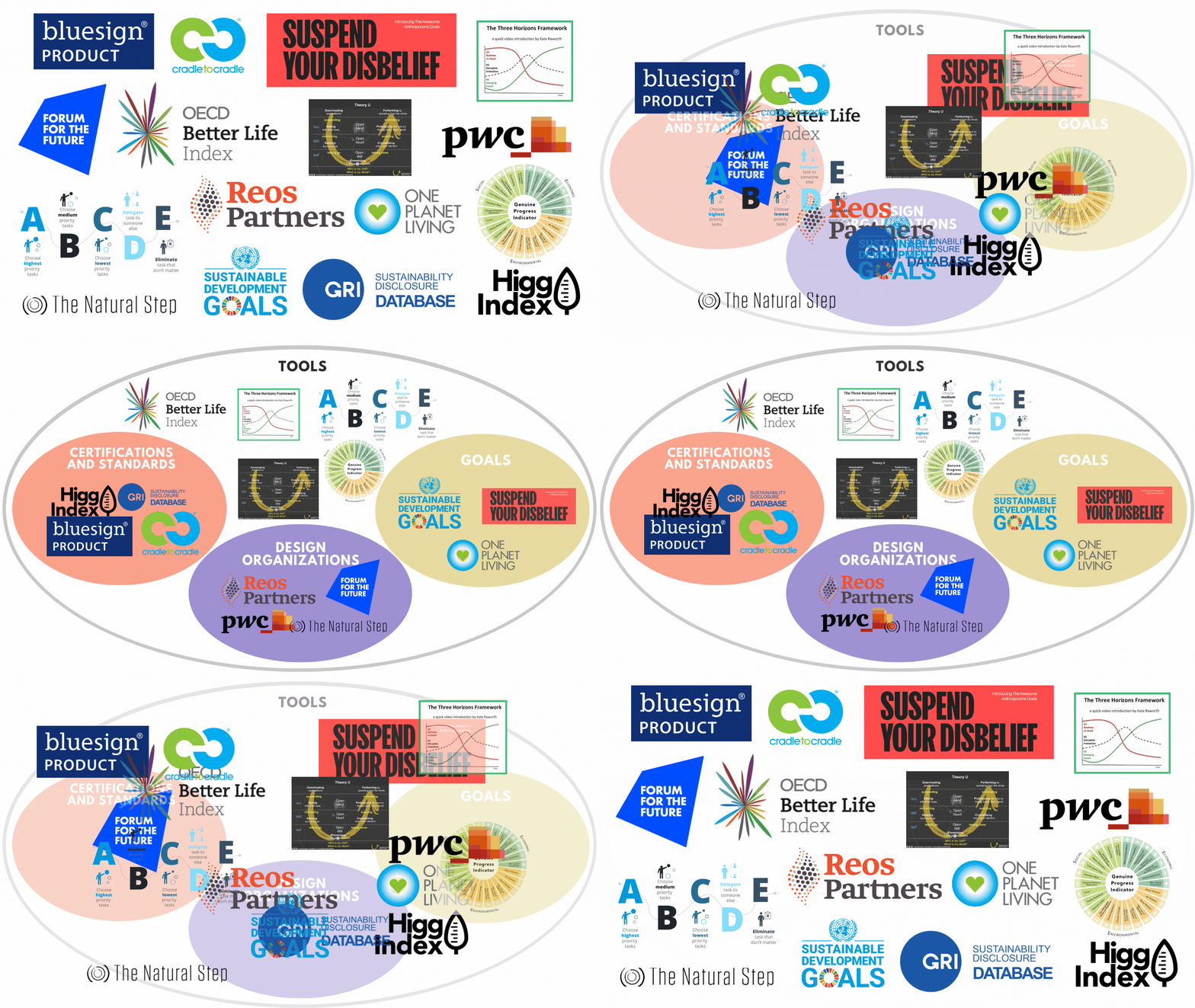
A collage of logos, charts, and graphics related to sustainability, innovation, and future planning, including the BlueSign product logo, cradle-to-cradle process, suspend your disbelief sign, three horizons framework, OECD Better Life Index, PwC logo, Reos Partners, One Planet Living, Global Reporting Initiative, and United Nations sustainable development goals.
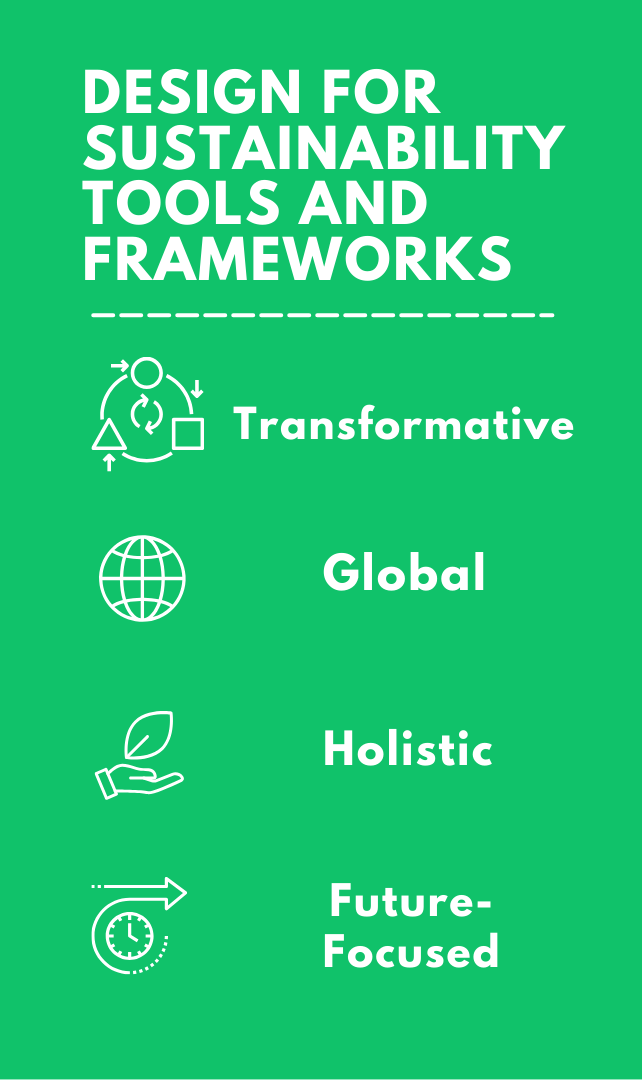
Green background with white text and icons. Title: "Design for Sustainability Tools and Frameworks". Four sections with icons: a cycle diagram labeled 'Transformative', a globe labeled 'Global', a hand holding a leaf labeled 'Holistic', and a clock with an arrow around it labeled 'Future-Focused'.

highlighted projects

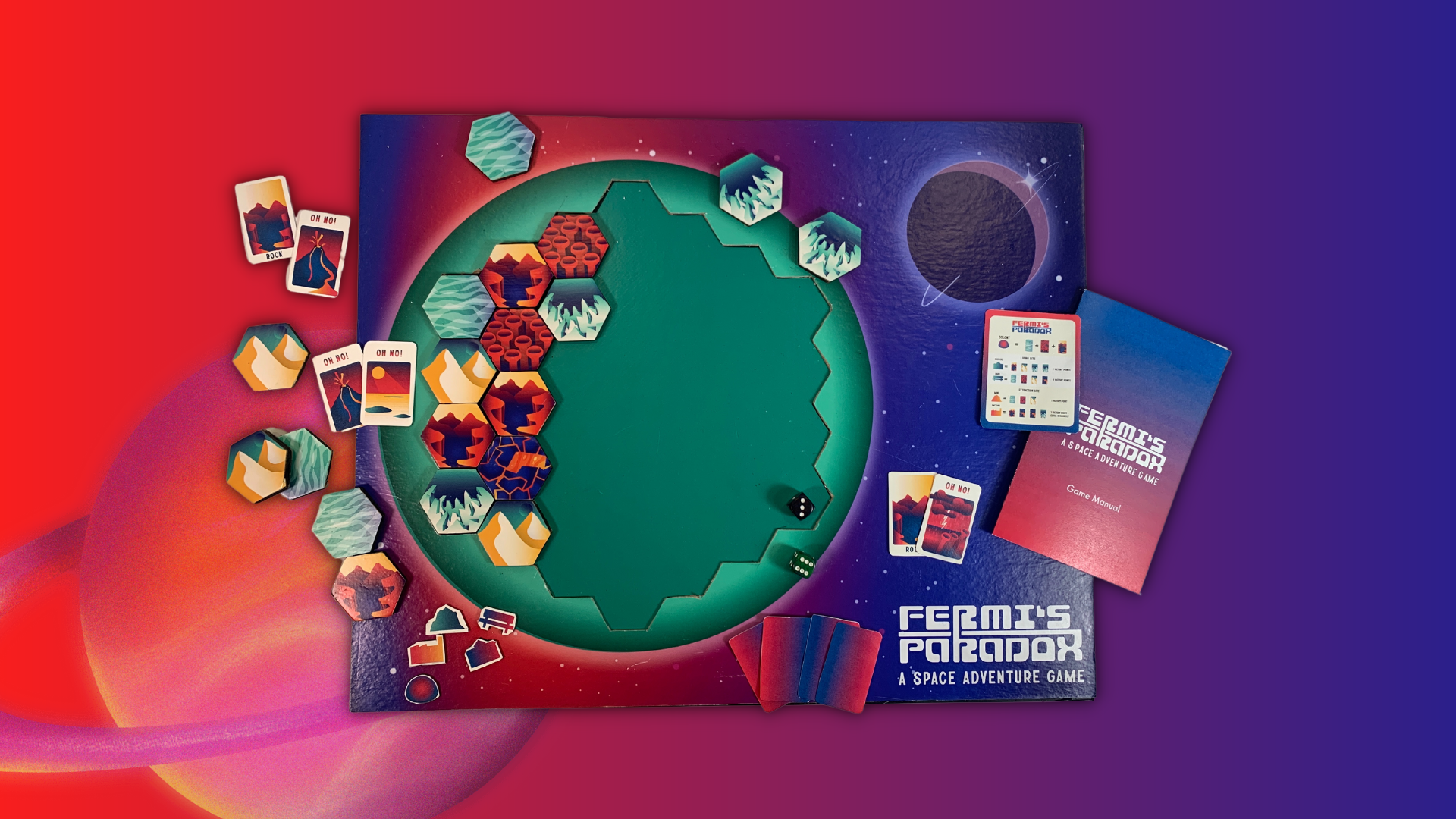
  • Fermi's Paradox Board Game

    In this space adventure, multi-player game, players compete to gain resources and build colonies on an alien planet. However, players better not take too much from the planet, or else all players lose the game.

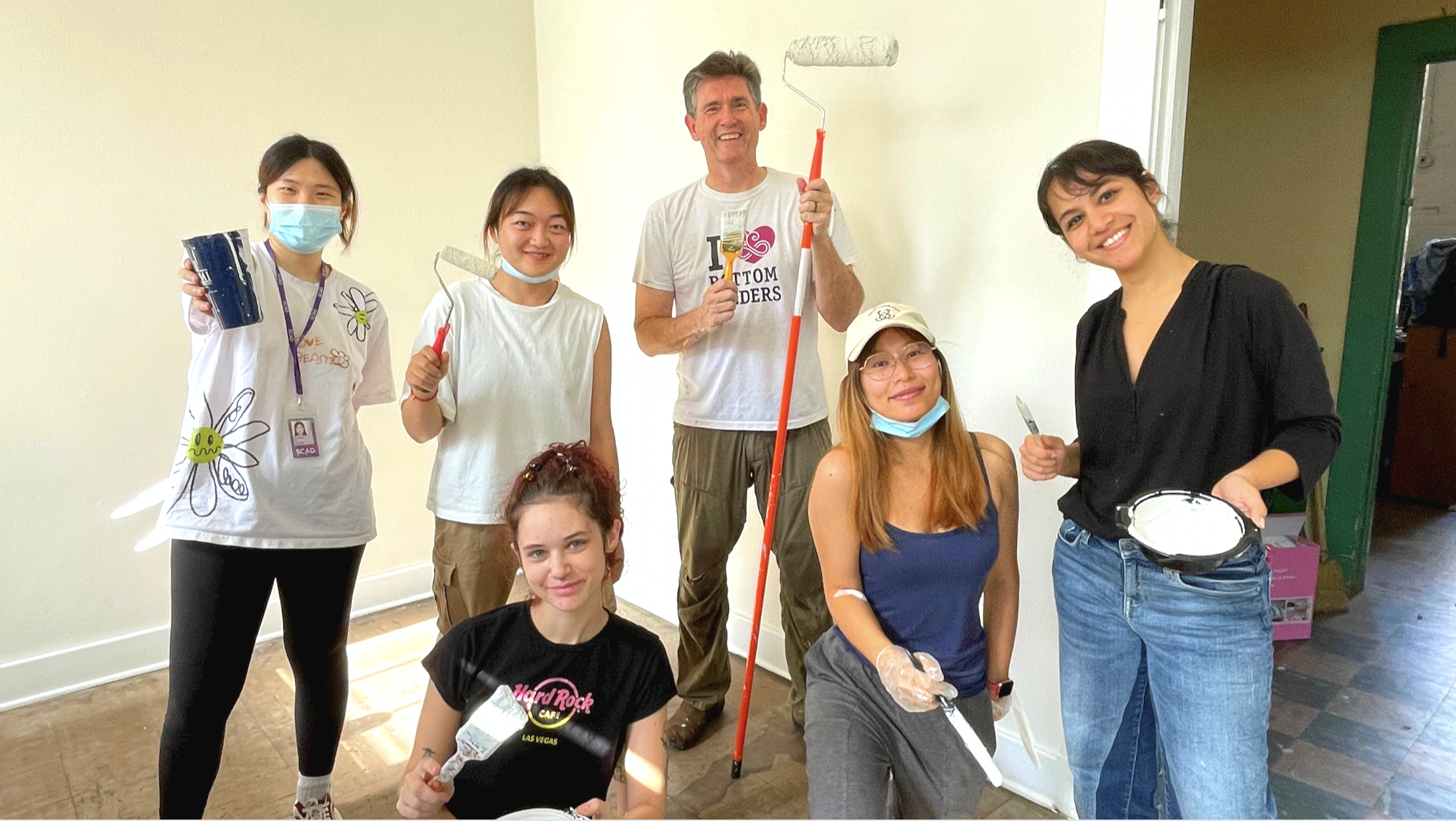
  • Emmaus House CLOTHING CLOSET

    Though SCAD Serve, our team collaborated with Emmaus House and the United Ministries of Savannah to reimagine the efficiency of their Clothing Closet, which provides essentials for Savannah’s unhoused population.

  • PELTE BIOMEMETIC SHADING DEVICE

    Though the study of biomimicry, Pelte was invented as an adaptive response to changing climate conditions, modeled after the Resurrection Fern, a plant native to Savannah.